LLM node
The Large Language Model (LLM) node is designed for data processing, analysis, and formatting. It enables you to interpret, generate, and transform data using OpenAI and AWS Bedrock-powered LLM models. Instead of defining complex flow logic, you simply provide a prompt, such as Identify eks clusters that are using a version that will expire in less than 90 days from today and return the clusters arn. The LLM node can then make the resulting data available to other nodes in the flow for further actions.
Furthermore, you can reference specific fields from the previous nodes in the flow to ensure more accurate and consistent output. The LLM node can then output the generated data to a single field or JSON object, making it available for the next step in the flow, such as sending a notification.
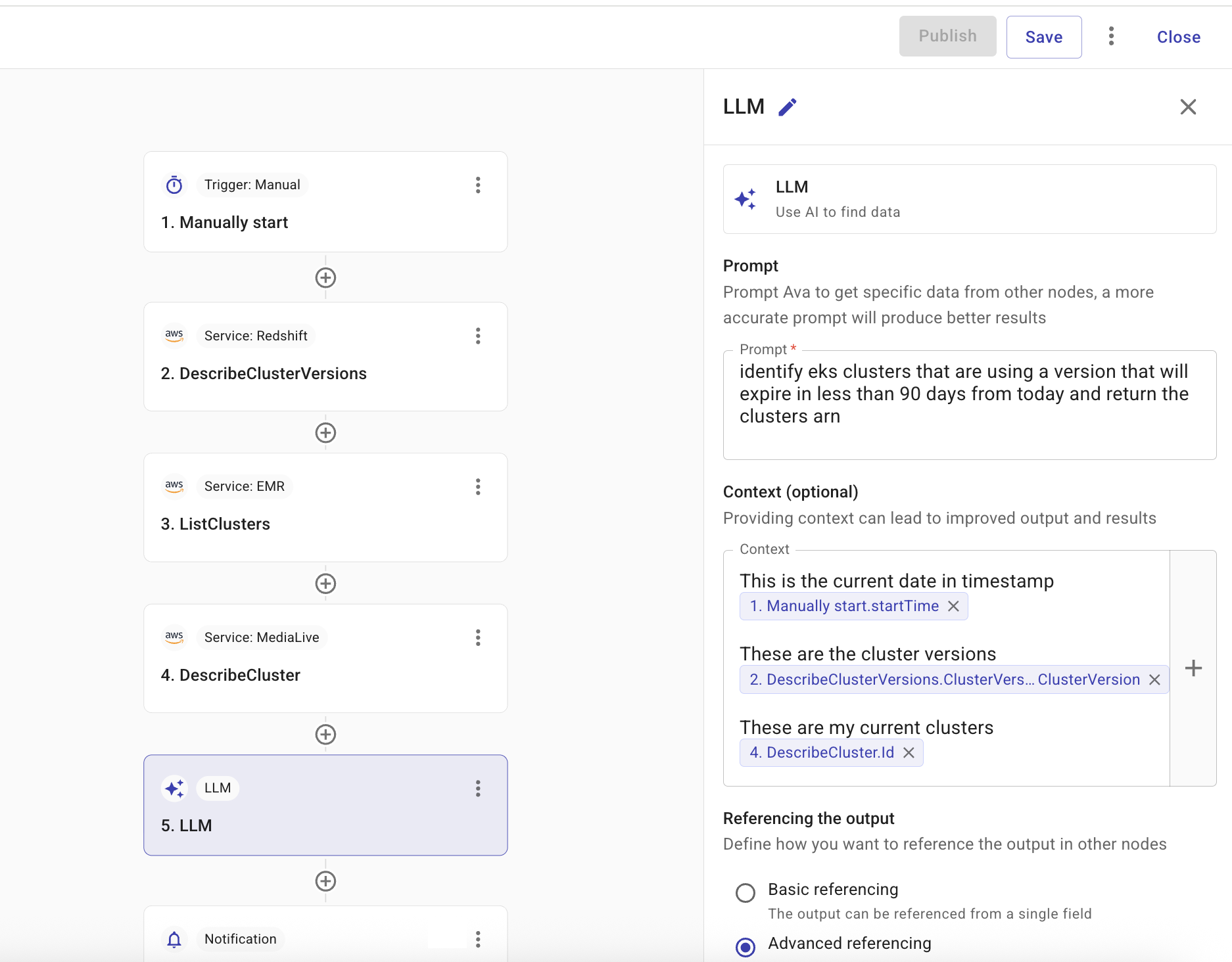
-
Prompt: Enter a prompt.
-
(Optional) Context: Add dynamic content to provide more context to the LLM model.
-
Referencing the output:
-
Basic referencing: The AI-generated output is referenced using a single field.
-
Advanced referencing: The AI-generated output is referenced using multiple fields (object). Define the fields to be referenced in a JSON schema.
-
In CloudFlow, the output schema describes only the value your node returns from its code or configuration. It does not describe the run metadata shown in execution logs.
When defining an output schema:
-
Match the top-level type exactly:
object,array,string,number,boolean, ornull. -
Define the shape recursively:
- If it’s an object, define
properties(and optionallyrequired). - If it’s an array, define
items(the schema for each element).
- If it’s an object, define
-
Avoid modeling CloudFlow’s execution wrappers (e.g.,
results,message,context). Those are part of the runtime envelope, not the node’s functional output.
Example patterns:
- Node returns an object:
{ "type": "object", "properties": { "foo": { "type": "string" } } }
- Node returns an array:
{ "type": "array", "items": { "type": "number" } }
Rule of thumb: write the schema for the JSON value you want a downstream node to receive if you copy-paste the node output as a standalone JSON document.
Test
Select Test to test the node.