Dashboard reports
You can add reports to dashboards created by you or organization dashboards that allow editing.
Required permission
-
Your DoiT account must have the Cloud Analytics User or Cloud Analytics Admin permission.
-
You can add only those reports to which you have access (see access reports).
Add existing reports
To add existing reports to a dashboard:
-
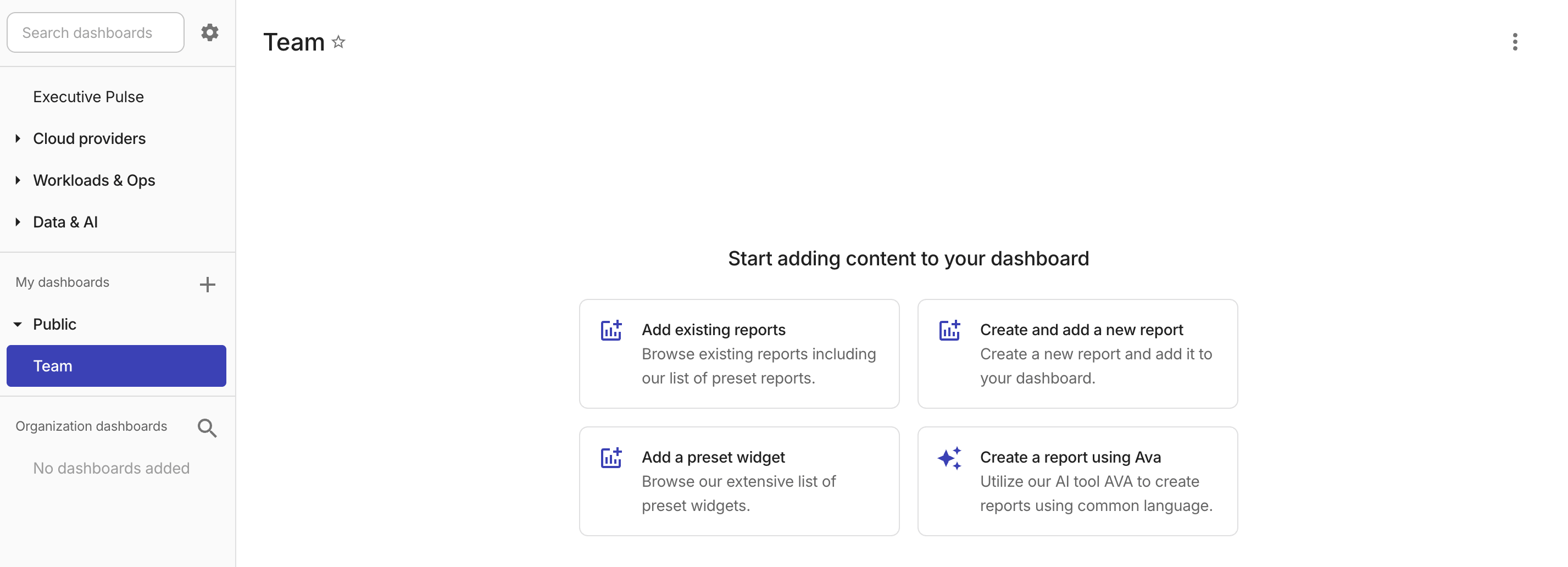
Go to the dashboard of interest.
-
Select Add existing report.
-
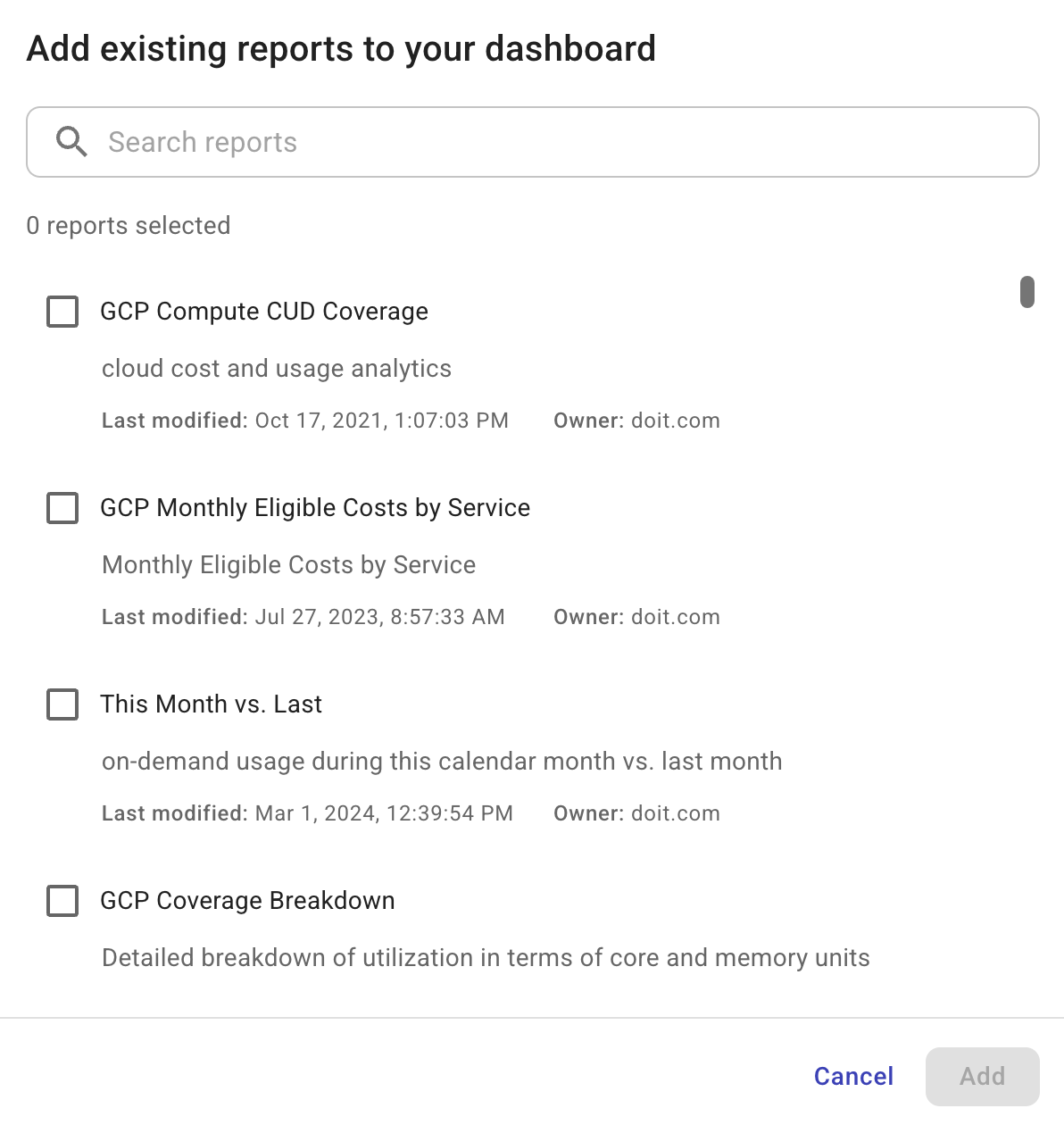
Select one or more reports from the list. Reports already on the dashboard are unavailable; to place a second, independently editable copy of one, see Duplicate a report widget.
-
Select Add.
Create and add a new report
You can also create a new report from a dashboard. This way, the new report will be added to the dashboard automatically.
-
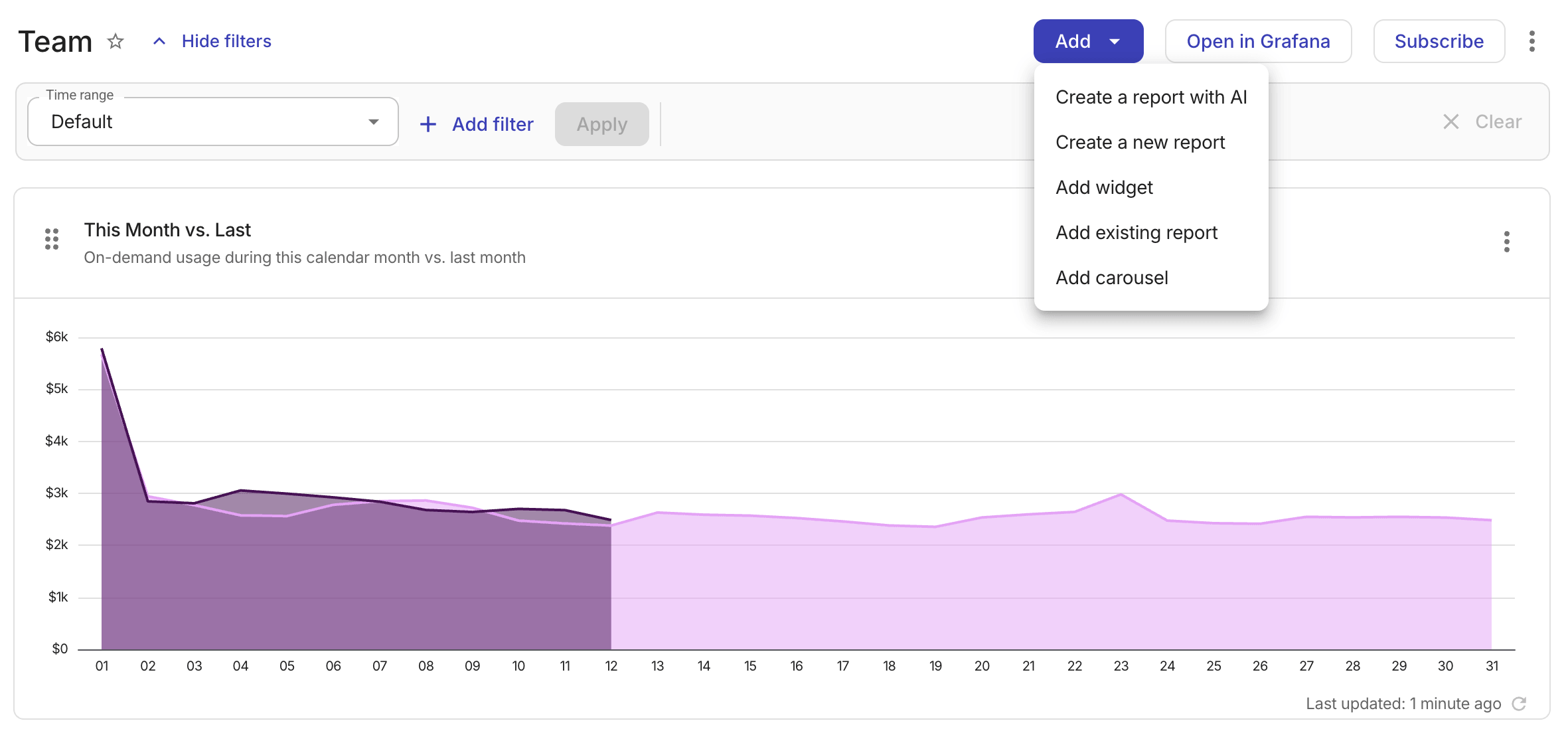
To create a report from scratch, select Add > Create a new report. It will take you to the report creation page.
-
If your DoiT plan includes the AI assistant, you can select Add > Create a report with AI to generate a report by chatting with our AI assistant. Once the report is generated, you can open it in Cloud Analytics for further adjustments. Make sure to save the report so it appears on the dashboard.
Dashboard time range and filters
Set time range and filters
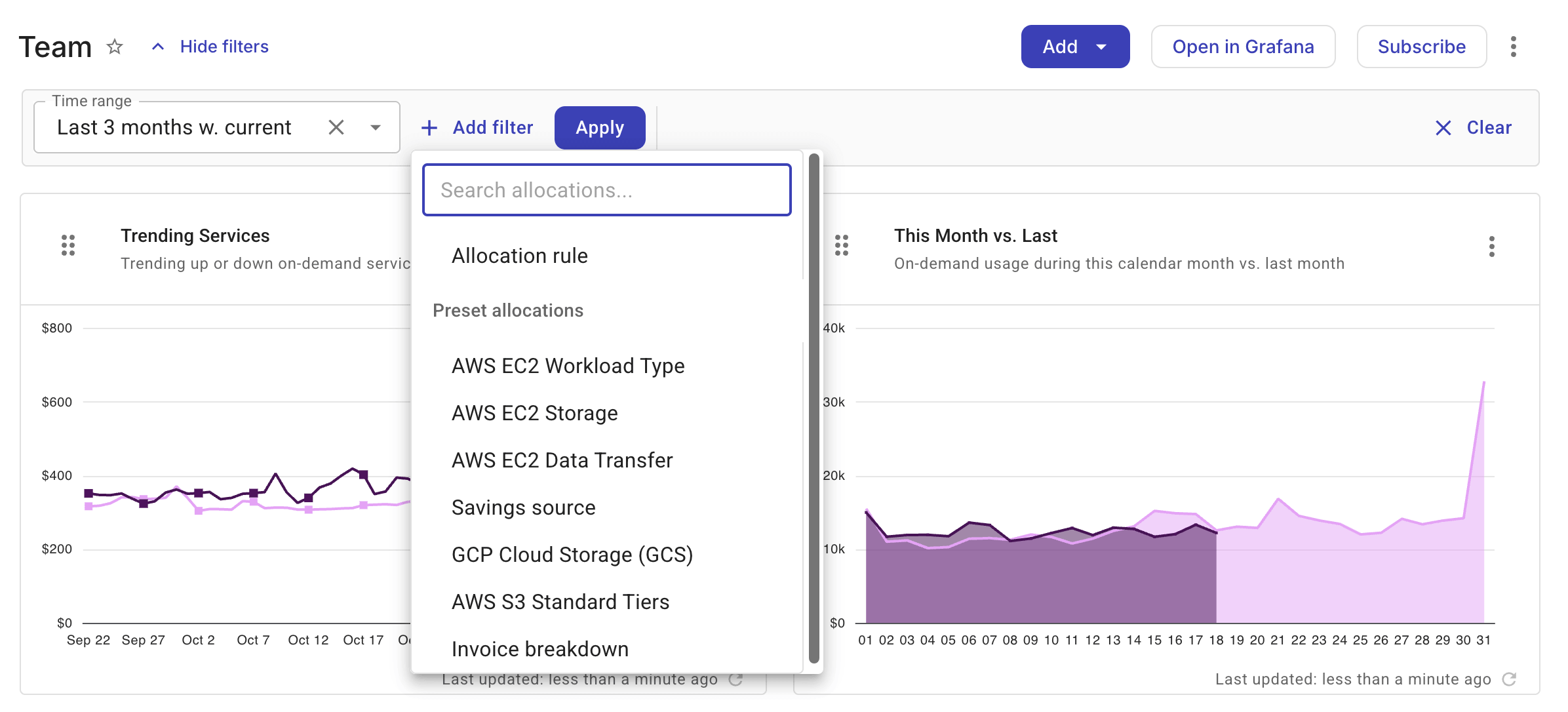
For a custom dashboard with multiple reports, you can set a single Time range at the dashboard level to get a consistent timeframe across all reports and Add filter to narrow down the displayed data, without having to adjust each report individually.
-
Time range
-
The dashboard time range options are the same as those available at the report level. You can choose a predefined time range or specify a custom one. (Once you choose a time range, the time interval is set automatically and cannot be adjusted.)
-
Setting the time range to
Defaultrestores each report to its default setting. -
The dashboard time range applies only within the dashboard. It doesn't affect the time range of a report if you open the report in Cloud Analytics.
-
-
Add filter
-
Dashboard filters allow only allocations, including allocation rules.
-
You can add up to three filters to a dashboard.
-
-
Apply: Changes to the dashboard time range and filters take effect only after you select Apply.
-
Clear: This option restores the dashboard's time range to
Defaultand removes all the applied filters.
How time range and filters work
Dashboard time range and filters are auxiliary resources and managed separately from other dashboard settings:
-
In the dashboard URL, time range and filter settings appear as an additional segment after the dashboard name. For example:
- Original:
https://console.doit.com/customers/{CUSTOMER_ID}/dashboards/{DASHBOARD_NAME} - With custom time range or filters:
https://console.doit.com/customers/{CUSTOMER_ID}/dashboards/{DASHBOARD_NAME}/{FILTER_SET_ID}
- Original:
-
When duplicating a dashboard, the copy doesn't inherit the time range and filters of the original one.
-
For an organization dashboard, if the owner updates the time range or filters, other users are presented with two options the next time they open the dashboard.
-
Save shared filters: Apply the time range and filters of the dashboard owner.
-
Discard changes: Retain the local settings.

-
Report widget options
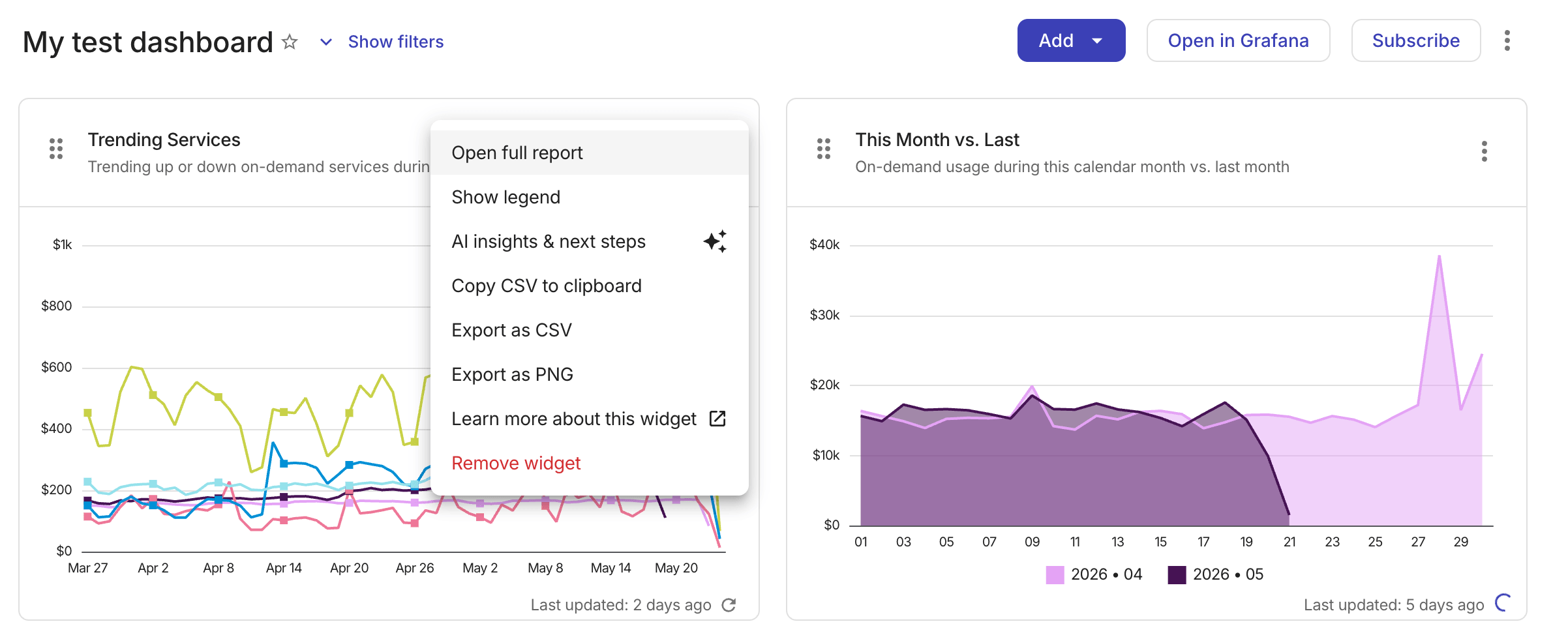
Report widget options are accessible from the kebab menu (⋮) in the upper-right corner of a widget:
-
Open full report: Opens the report in Cloud Analytics.
-
Duplicate widget: Creates a copy of the widget next to the original. See Duplicate a report widget.
-
Show/Hide legend: Shows or hides report legends.
-
AI insights & next steps: Provides insights based on the report. Available if your DoiT plan includes the AI assistant.
-
Copy CSV to clipboard, Export as CSV/PNG: See Export reports.
-
Remove widget: Removes the widget from the dashboard, and offers to delete the report behind it. See Remove a report widget.
Duplicate a report widget
Duplicating a widget is the quickest way to build a variation of a report you already have on the dashboard: the same grouping with an extra filter, or the same data over a different period.
Because a report widget has no settings of its own, duplicating one also creates a copy of the report behind it. The copy appears in Reports alongside your other reports, and you're its owner regardless of who owned the original.
To duplicate a report widget:
-
Select the kebab menu (⋮) in the upper-right corner of the widget, then select Duplicate widget.
-
Adjust the Time range, Group by, and Filters if you want the copy to differ from the original. Selecting a dimension opens the same filter options you get in Cloud Analytics.
-
Review the Name and Description. If your DoiT plan includes the AI assistant, both are suggested from the settings you chose; otherwise the copy is named
Copy of <original name>. You can edit either field, and select the sparkle icon to request a new suggestion after changing the settings. -
Select Duplicate.
The copy is placed directly after the original in the dashboard layout, at the same width, and runs its first query straight away, so it shows a loading state until the data arrives. Everything else about the report — metrics, renderer, comparison, and forecast — is inherited from the original and can be changed by opening the copy in Cloud Analytics.
Duplicating is also how you get the same report onto a dashboard twice: Add existing report skips reports that are already on the dashboard.
Remove a report widget
Selecting Remove widget asks you to confirm, because removing a widget can also delete the report behind it.
-
If you own the report and it isn't a preset report, Also delete the report is selected by default, and the confirmation shows the report's owner and when it was last updated. Clear the checkbox to keep the report in Cloud Analytics and remove only the widget.
-
Otherwise the report is kept, and the confirmation tells you so.
If the report is also used by widgets on other dashboards, the confirmation names those dashboards. Deleting the report leaves those widgets without data.
Report legends
Report widgets on a dashboard can display legends that map colors to data series, making it easier to identify series at a glance. Legends are hidden by default.
-
To toggle the legend for a single report, select the kebab menu (⋮) in the upper-right corner of the widget and choose Show legend or Hide legend.
-
To show or hide legends for all reports on the same dashboard at once, use the Dashboard management options. You can still adjust individual widgets afterward.
Legend preference is saved per user, per widget, and per dashboard.
Export reports
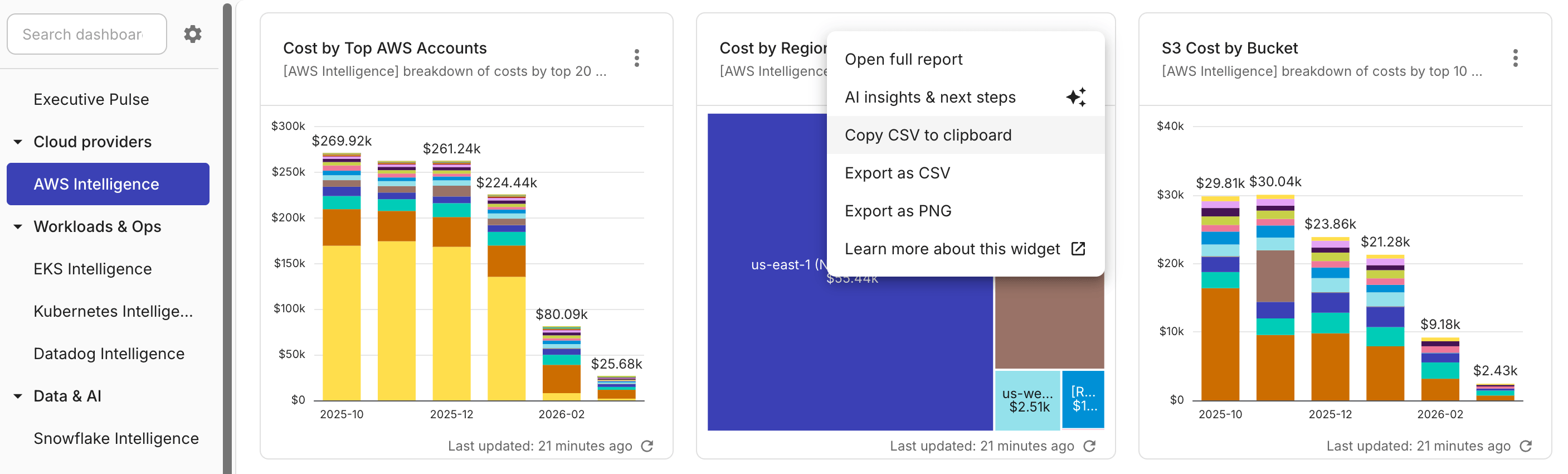
If a report has been rendered successfully on a dashboard, you can export it by selecting the kebab menu (⋮) in the upper-right corner and choosing a desired format:
-
Copy CSV to clipboard: Exports the pivoted data you see in the console to the clipboard.
-
Export as CSV: Exports the pivoted data you see in the console to CSV.
-
Export as PNG: Exports the chart you see in the console to a PNG file.
Drill down into report widgets
Report widgets support the same drilldown as an open report, so you can break spend down from Provider to Service to SKU without leaving the dashboard. Drilling is available on custom dashboards and on Intelligence dashboards, for widgets whose reports meet the drilldown conditions. You also need access to the report behind the widget (see access reports).
To drill down, select a bar, column, line point, or area segment, or right-click a chart element and select Drill down by dimension.
A breadcrumb trail appears above the chart to show your current level. Select an earlier level in the trail to jump back to it, right-click the chart and select Drill up to return one level, or select Back to saved view to restore the widget as saved.
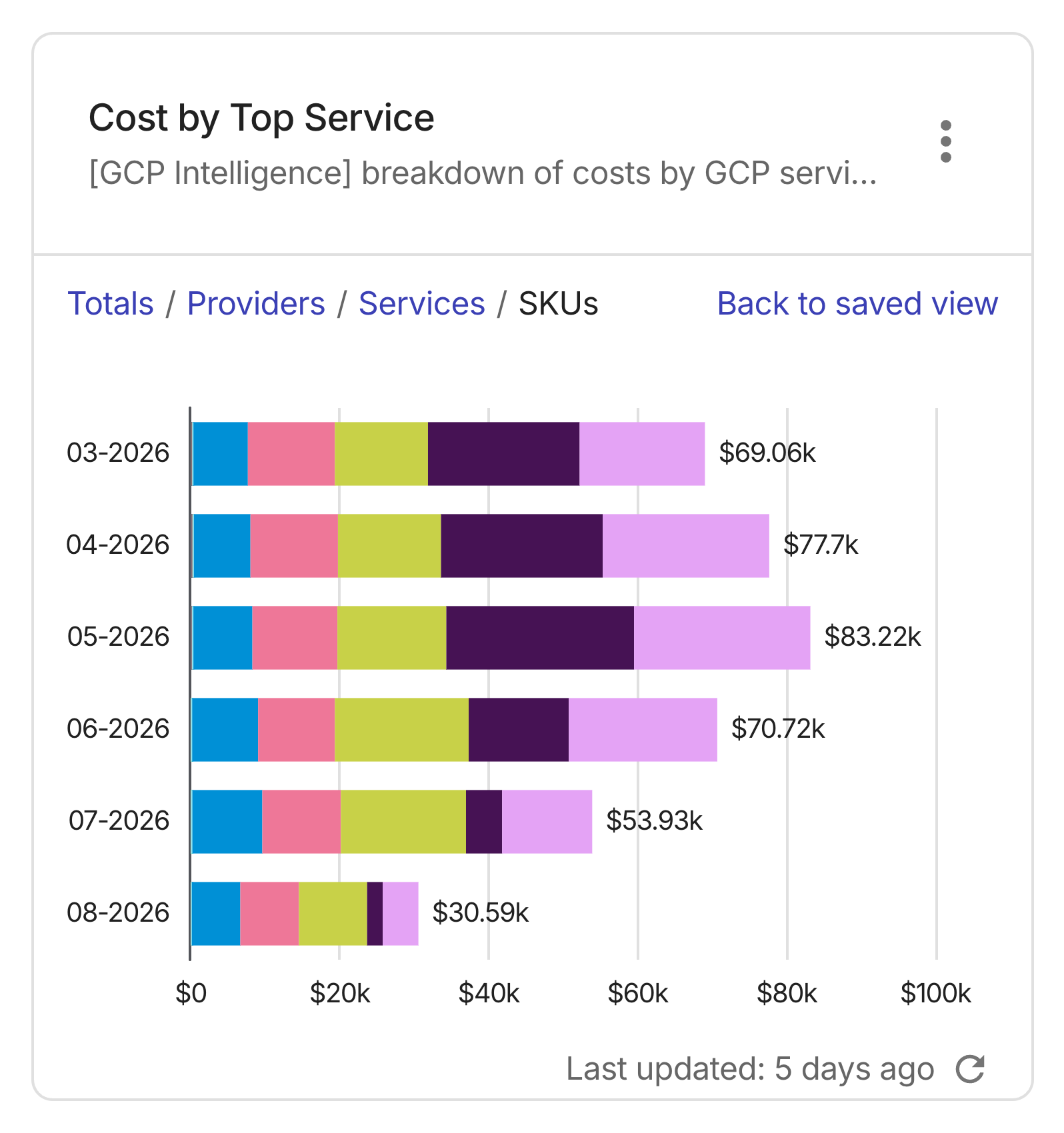
Drilling affects only your own view: it doesn't change the report behind the widget or what other users see, and the widget returns to its saved view when you reload the dashboard.