
Access reports

Required permission

  • Cloud Analytics Read Only, Cloud Analytics User, or Cloud Analytics Admin
Permissions on custom reports

A custom report is visible only to those with whom the owner has shared it or those with the Cloud Analytics Admin permission. See Share reports for more information. If you've set up the Organizations feature, be aware that reports shared outside an organization are not visible within.

Access reports

To access Cloud Analytics reports, sign in to the DoiT console, select Reporting and analytics > Reports from the top navigation mega menu.
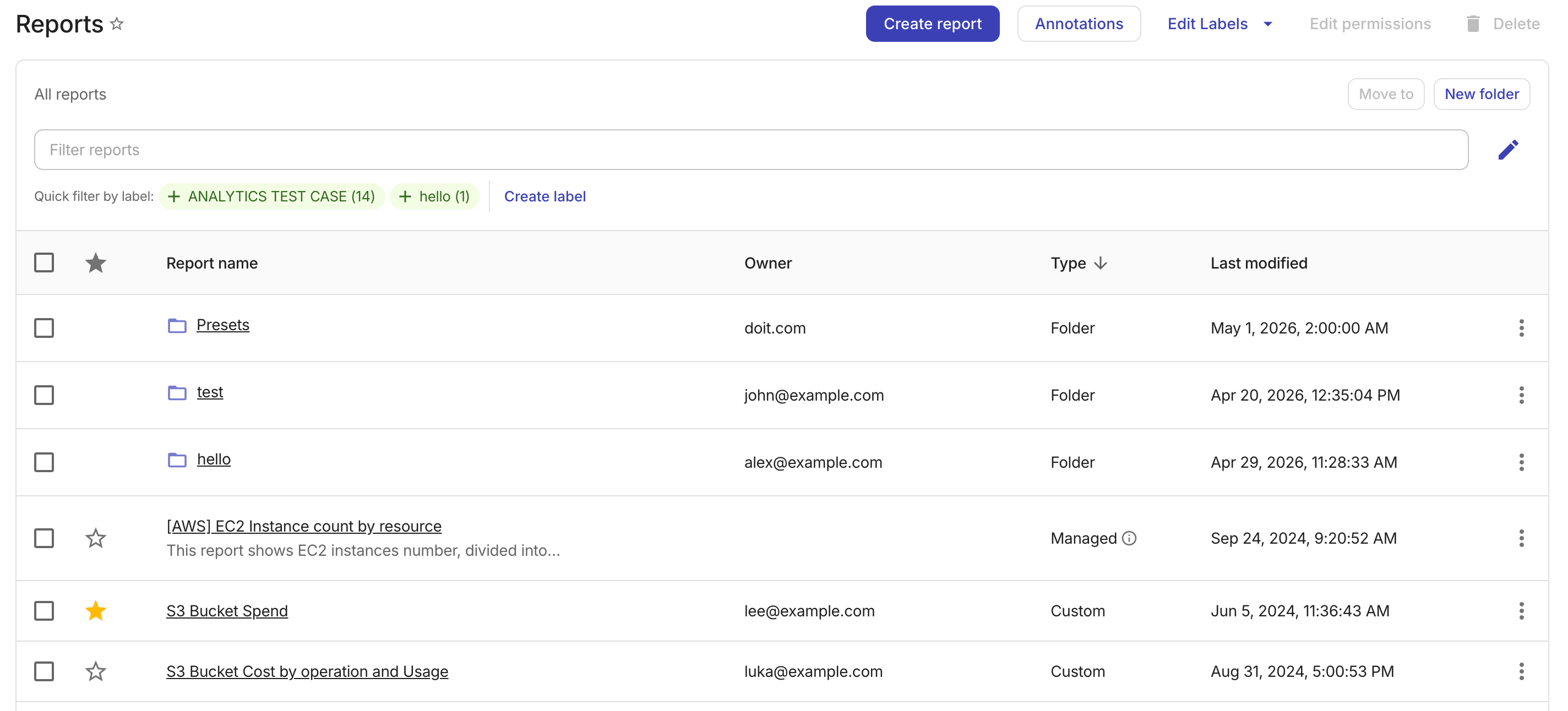
The Reports screen.

The Reports list is displayed in the following order:

  • A read-only Presets folder that contains all preset reports. This folder is maintained by DoiT and cannot be renamed, moved, or deleted.

  • Folders created by you and other users in your organization to group custom reports.

  • Managed reports maintained by DoiT.

  • Custom reports not in any folders.

You can filter reports by property; the results include matches from any folder. You cannot filter folders at the moment.

View a report

To view a report, select its name on the main Reports screen.

An example report

Tip

Select the kebab menu () in the report title bar and choose Report configuration to view the report details.

Search in table

To ensure optimal performance, tabular reports (Tables and Heatmaps) render only the rows and cells currently visible on your screen. Because standard browser search cannot detect unrendered rows, finding specific values in high-volume analytics reports requires scrolling manually, which is often impractical.

DoiT console enhances the standard Ctrl+F and Cmd+F shortcuts with a custom global search. This allows you to search across your entire table, regardless of whether the rows are currently hidden from view.

Search in tabular report

  • The search scans both dimension label columns and metric value columns.

  • The search is case-insensitive and matches any substring within a cell.

  • The search matches against formatted values as they appear on screen, not the underlying raw data.

Compact mode

When Compact UI is enabled, the report uses smaller typography, tighter spacing, and a narrower side panel to maximize space for the chart and table.

All report configuration options remain available in compact mode, though some move to different locations:

An example report in compact mode