Create a new user
You can manage the access of other users on behalf of the organization, as well as create users for new employees who need access to the platform.
Required permission
- User Manager
Allowed invite domains
When you invite a user, the email address must belong to a permitted domain. The system checks the address against an effective list of allowed domains that includes:
-
Your organization's approved domains from General Settings
-
Any additional domains in the Allowed invite domains list in General Settings
-
Ancestor organization domains, for child tenants in a multi-tenant hierarchy
-
Auto-provisioning domains, when auto-provisioning is enabled
Domain matching is exact and case-insensitive. A subdomain such as sub.example.com does not match its parent domain example.com, and vice versa.
Editing this list requires the Users Manager permission.
By default, the Invite dialog blocks email addresses from free email providers such as Gmail, Yahoo, and Hotmail. If your organization has configured Allowed invite domains, free email addresses on that list are accepted in the dialog. For other free email domains not on the list, the server evaluates the invite against your organization's full domain configuration.
If auto provisioning is enabled, any user with an email address from your organization's domain can sign up without being invited.
Unique email prefixes
If your organization has multiple domains, email addresses that share the same prefix (local part) across domains are treated as the same user.
For example, if [email protected] already has an account or an active invite, you cannot invite [email protected] because both addresses resolve to the same user identity.
This also applies when importing users via CSV. Rows with prefix conflicts are reported as errors in the import results.
Allow free email invitees
Allow free email invitees is a per-organization setting that bypasses all invite domain restrictions. It allows you to invite users with any email address, including addresses from free email providers such as Gmail, Yahoo, and Hotmail.
This setting is not available in the console by default. Contact your DoiT account manager to enable it.
When the setting is enabled for your organization, you can add free email addresses in the Invite dialog. Note that unmanaged accounts are not subject to your organization's identity, security, or governance controls.
Allowing logins from free email accounts means you lose the ability to manage user passwords, control what they can access, or manage what happens to your data over time.
Invite new users
Invite users from the Users page to grant them access to Cloud Intelligence and assign a role.
To invite new users:
-
Sign in to the DoiT console, select the gear icon () from the top navigation bar, and then select Users and access.
-
Select Users from the left-hand menu.
-
Select Invite user next to the filter bar.

-
In the Invite users dialog, add one or more email addresses you want to invite.
-
Select a role for the new users.
-
(Optional) If your organization is part of a multi-tenant hierarchy and has geographic access controls enabled, select a Geographic access scope for the new users. See Scope types for details.
You can also choose to continue to edit their user profiles.
-
Select Invite.
The recipients you invited will receive an email that contains a link that they should use to complete sign up for a platform account.
Manage invitations
After you invite a user, you can track and manage the invitation from the Users page. Each invited user displays a status indicating the current state of their invitation. You can resend expired or cancelled invites, cancel pending invites, and see when an invite has expired.
-
Invited: The invite has been sent and is waiting for the recipient to accept.
-
Expired: The invite was not accepted before it expired.
-
Cancelled: The invite was cancelled by an administrator.
-
Active: The user accepted the invite and their account is active.
Resend an invite
You can resend an invitation to generate a fresh invite link for invitations with an Invited, Expired, or Cancelled status. Resending an invite sends a new invitation email and resets the invite status to Pending.
To resend an invite:
-
On the Users page, find the user whose invite you want to resend.
-
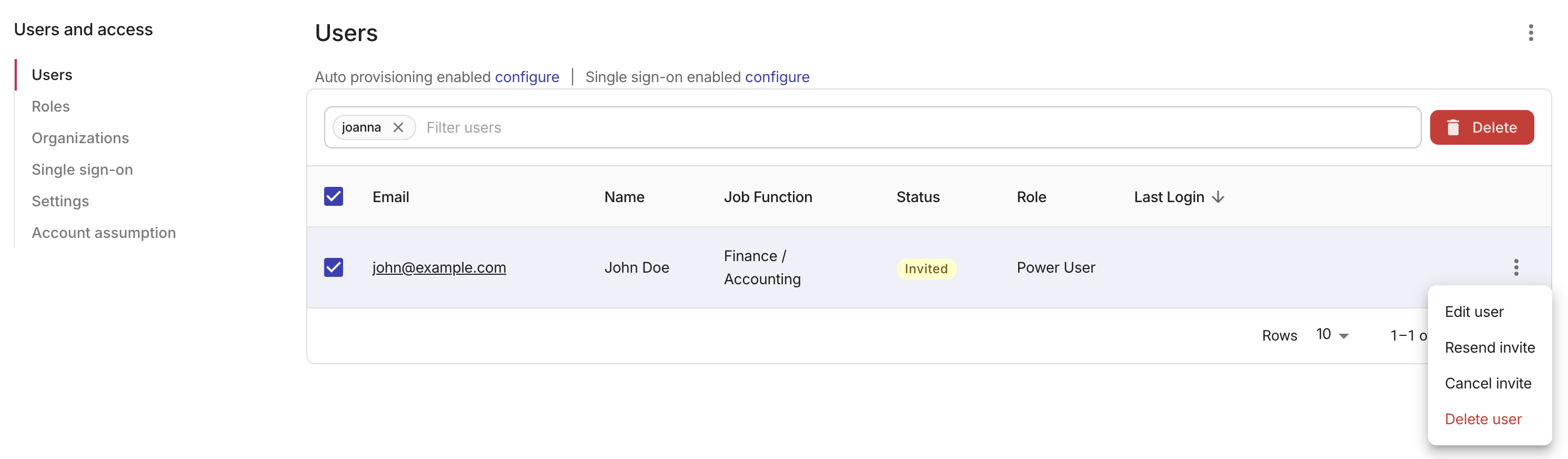
Select the three-dot menu (⋮) at the rightmost end of the user whose invite you want to resend, and then select Resend invite.
A confirmation message appears once the invite has been resent. The user receives a new invitation email with an updated sign-up link. Any previously sent invitation links are invalidated.
If the resend is rejected — for example, because the email domain is not on the allowed invite domains list — the reason is displayed in an error message.
Cancel an invite
If you invited a user by mistake or no longer want them to join, you can cancel the invite while it is still pending. Canceling an invite invalidates the invitation link so the recipient can no longer use it to sign up.
You can only cancel invites that are still Invited. Expired or already-accepted invites cannot be cancelled.
To cancel a pending invite:
-
On the Users page, select the three-dot menu (⋮) at the rightmost end of the user whose pending invite you want to cancel.
-
Select Cancel invite.
-
Select Cancel invite to confirm.
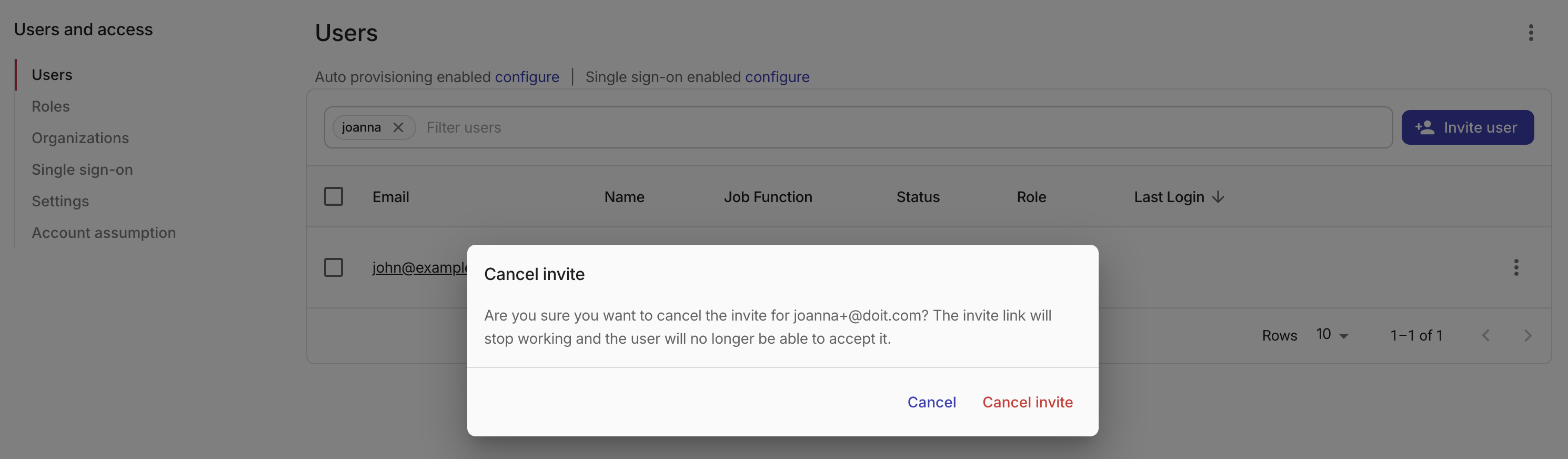
The user's invite status changes to Cancelled and the invitation link stops working. If a recipient tries to use an invitation link that has been cancelled, they see a message indicating that the invite is no longer valid and to contact their administrator for a new invitation. If you later decide to grant this person access, you can send a new invite.
Edit user profiles
There are two ways you can access the page to edit a user's profile:
-
Select the Continue to edit user profile checkbox when inviting them.
-
Select their email on the Users page.
On the user profile page, you can update the user's personal details, language preference, default dashboard, and geographic access scope.
If your organization is part of a multi-tenant hierarchy and has geographic access controls enabled, the Geographic access field appears on the profile. Saving the profile with an updated geographic scope takes effect immediately.
See Your profile for more information.
Edit or delete
To delete a single user from your organization:
-
On the Users page, select the three-dot menu (⋮) at the rightmost end of the user you want to delete.
-
Select Delete user.
-
Select Delete to confirm.
To bulk update users in your organization:
-
Select the checkboxes next to the users you'd like to update.
-
Select Edit.
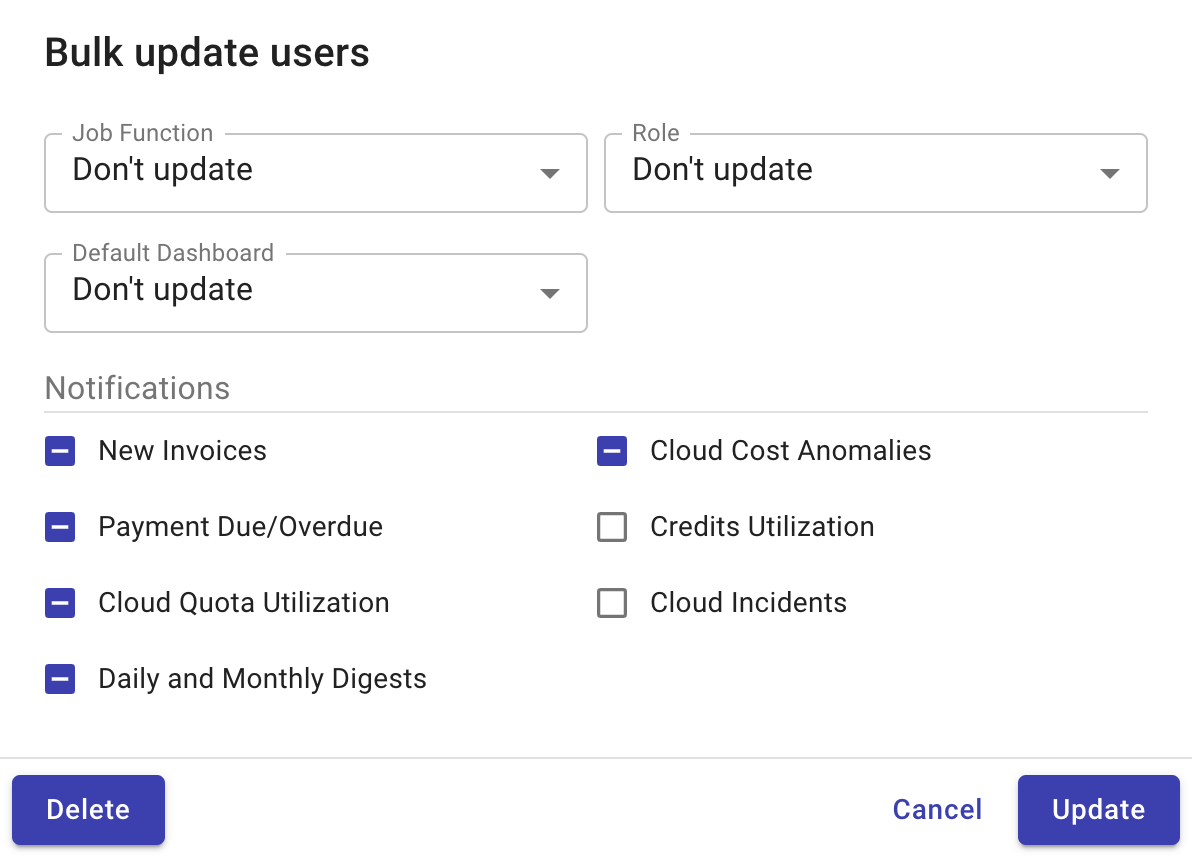
See Notifications for more information about notification options.
-
Once you've made your changes, select Update to confirm.
To bulk delete users from your organization, select Delete.