Create and manage variables
This page explains how to create and manage variables in flows, including creating, editing, and deleting.
The connection types available when you create variables, and the connection-type variables visible in the variables list and flow builder panel, depend on which cloud providers are enabled for your organization. If a cloud provider is not enabled, its connection type does not appear as an option and existing connection-type variables for that provider are hidden.
Create variables
How you create variables depends on the scope of the variable. You can create global variables in two ways: by selecting Variables in the CloudFlow sidebar, or in the flow builder when defining a flow. Local variables can only be created in the flow builder when you are creating or editing a flow.
Global variables
Global variables can be created either centrally from the CloudFlow sidebar or directly from within a flow.
Create global variables centrally
You can create and manage your global variables from Variables in the CloudFlow sidebar, allowing you to define known and reusable data before you start building your flows. This saves time by making your global variables immediately available across all your flows, as you create or edit them. If you select Variables from the sidebar, the variables you manage here are shared across every workspace in your organization. They are not limited to your currently selected workspace.
-
Select Automation and operations from the top navigation mega menu, select CloudFlow.
-
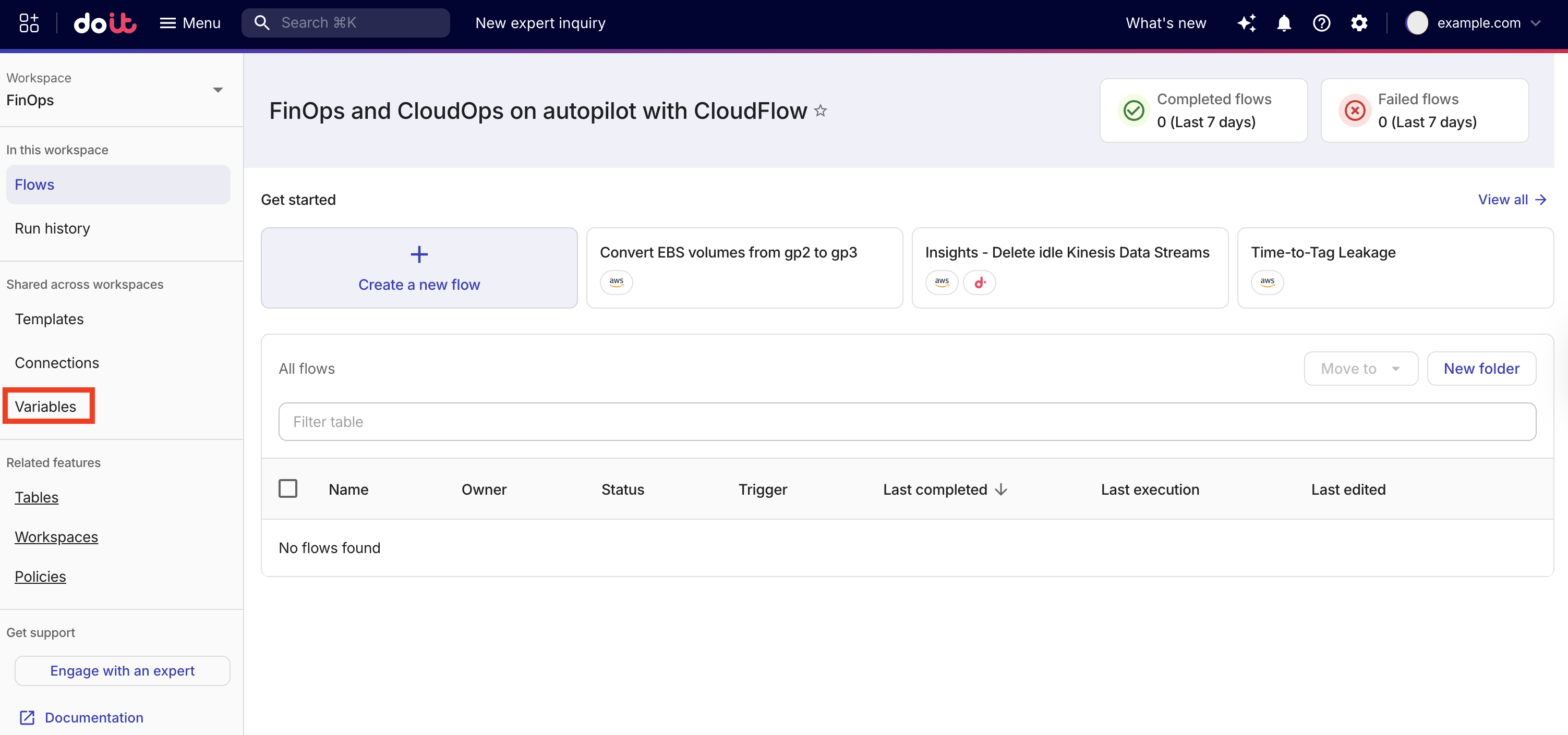
In the CloudFlow sidebar, select Variables.
-
Select Create global variable.
-
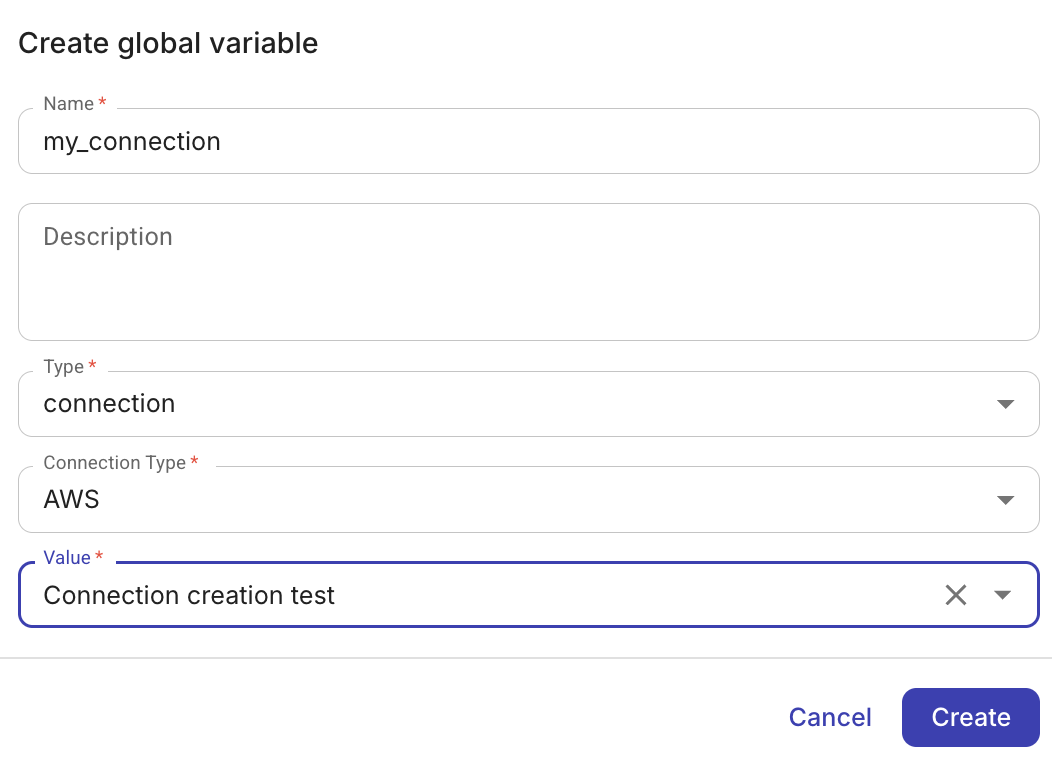
Define the variable:
-
Name: A name that fits the usage of the variable. Names must start with a letter or underscore and contain only letters, numbers, and underscores.
-
(Optional) Description: A brief description of what the variable is for.
-
Type: The variable's data type. Allowed values:
string,integer,float,boolean,list,connection. If you choose list, you must also set Element Type. If you choose connection, you must also set Connection Type. -
Element Type: The type of each item in the list. Shown only when Type is list. Allowed values:
string,integer,float,boolean. -
Connection Type: The provider for the connection. Shown only when Type is connection. Possible values include AWS, GCP, OpenAI, and Anthropic. The options shown depend on which providers are enabled for your organization.
-
Value: The value of the variable. For a list variable, add or remove items; each item must match the element type. For a connection variable, select one of your organization's connections for the chosen Connection Type.
-
-
Select Create. You can now add the variable to a flow.
Create global variables within a flow
You can create global variables from within a flow. Global variables created within a flow are immediately available for use across all your flows.
Global variables created in a flow are managed from Variables in the CloudFlow sidebar (open the Global variables tab).
-
Create a new flow, or edit an existing one.
-
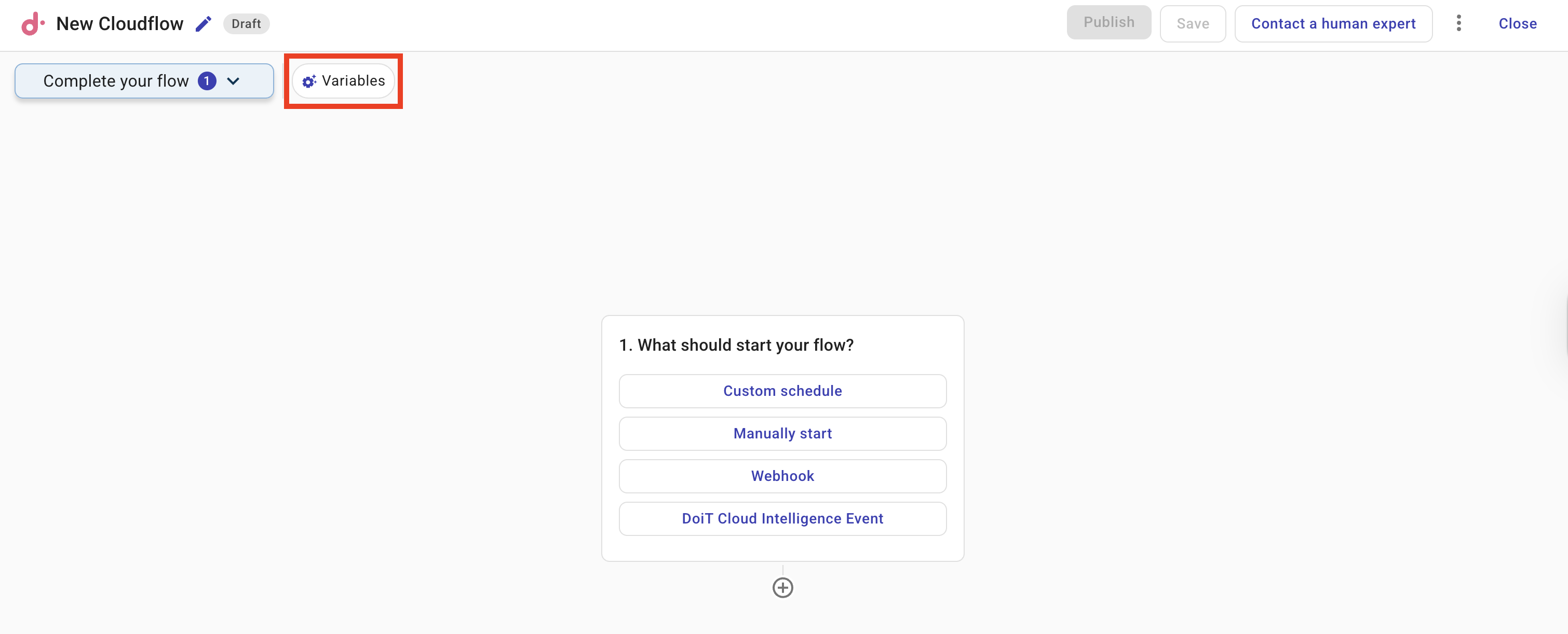
From the flow, select Variables. The variables panel shows two tabs: Local variables and Global variables.
-
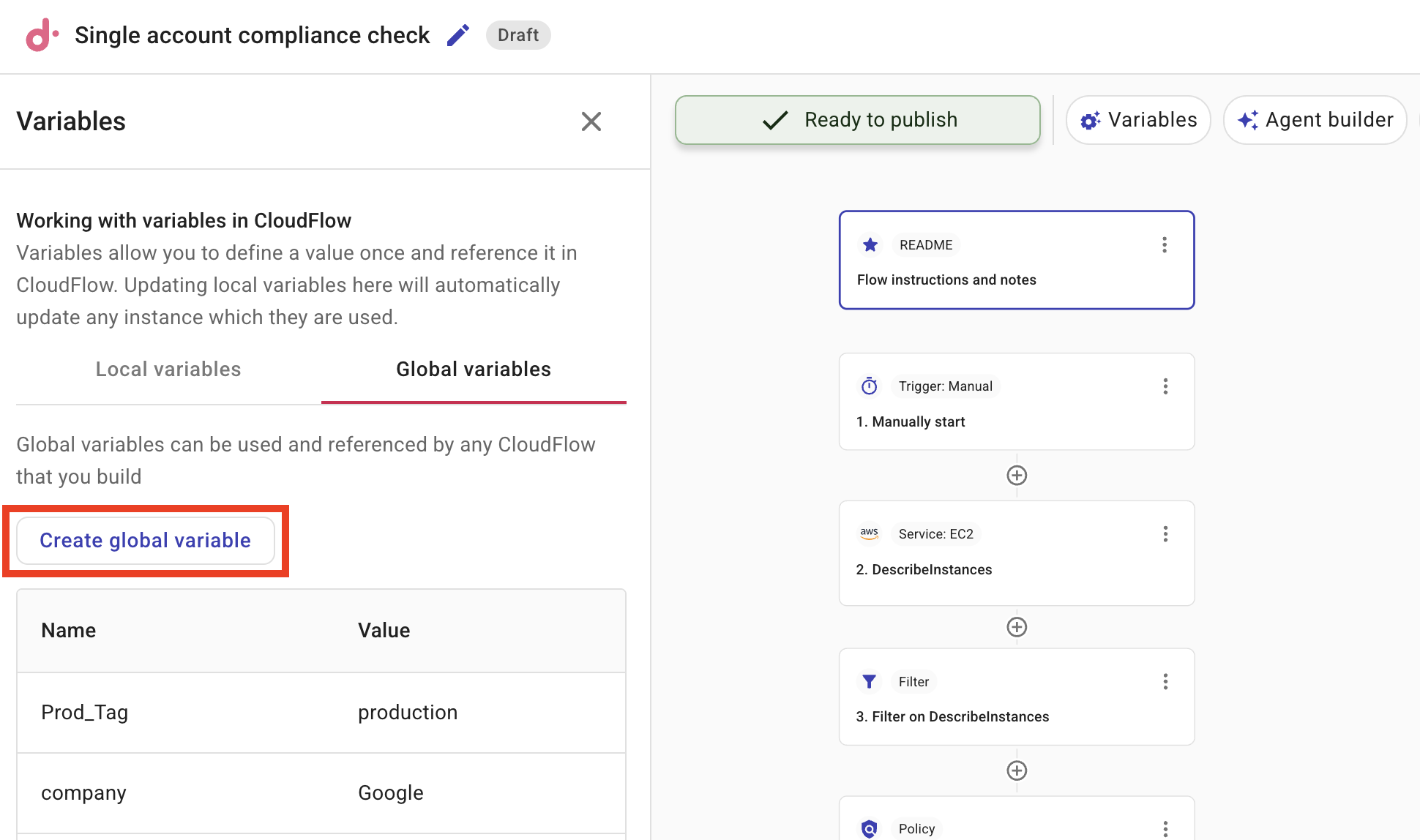
Select the Global variables tab and select Create global variable.
-
Define the variable:
-
Name: A name that fits the usage of the variable. Names must start with a letter or underscore and contain only letters, numbers, and underscores.
-
(Optional) Description: A brief description of what the variable is for.
-
Type: The variable's data type. Allowed values:
string,integer,float,boolean,list,connection. If you choose list, you must also set Element Type. If you choose connection, you must also set Connection Type. -
Element Type: The type of each item in the list. Shown only when Type is list. Allowed values:
string,integer,float,boolean. -
Connection Type: The provider for the connection. Shown only when Type is connection. Possible values include AWS, GCP, OpenAI, and Anthropic. The options shown depend on which providers are enabled for your organization.
-
Value: The value of the variable. For a list variable, add or remove items; each item must match the element type. For a connection variable, select one of your organization's connections for the chosen Connection Type.
-
-
Select Create. You can now add the variable to a flow.
Local variables
You must be creating or editing a flow to create a local variable.
-
Select Automation and operations from the top navigation mega menu, and then select CloudFlow.
-
Create a new flow, or edit an existing one.
-
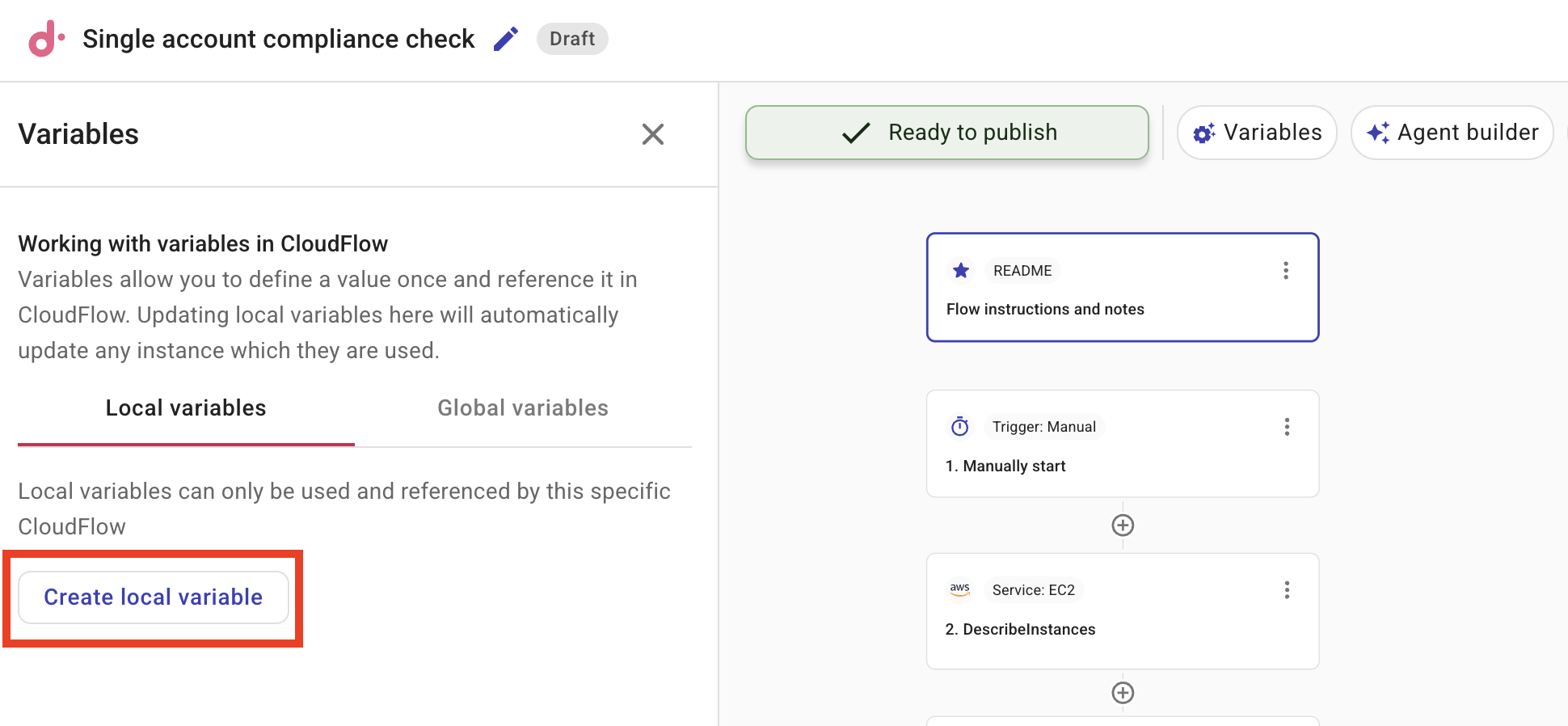
From the flow, select Variables. The variables panel shows two tabs: Local variables and Global variables.
-
Select the Local variables tab and select Create local variable.
-
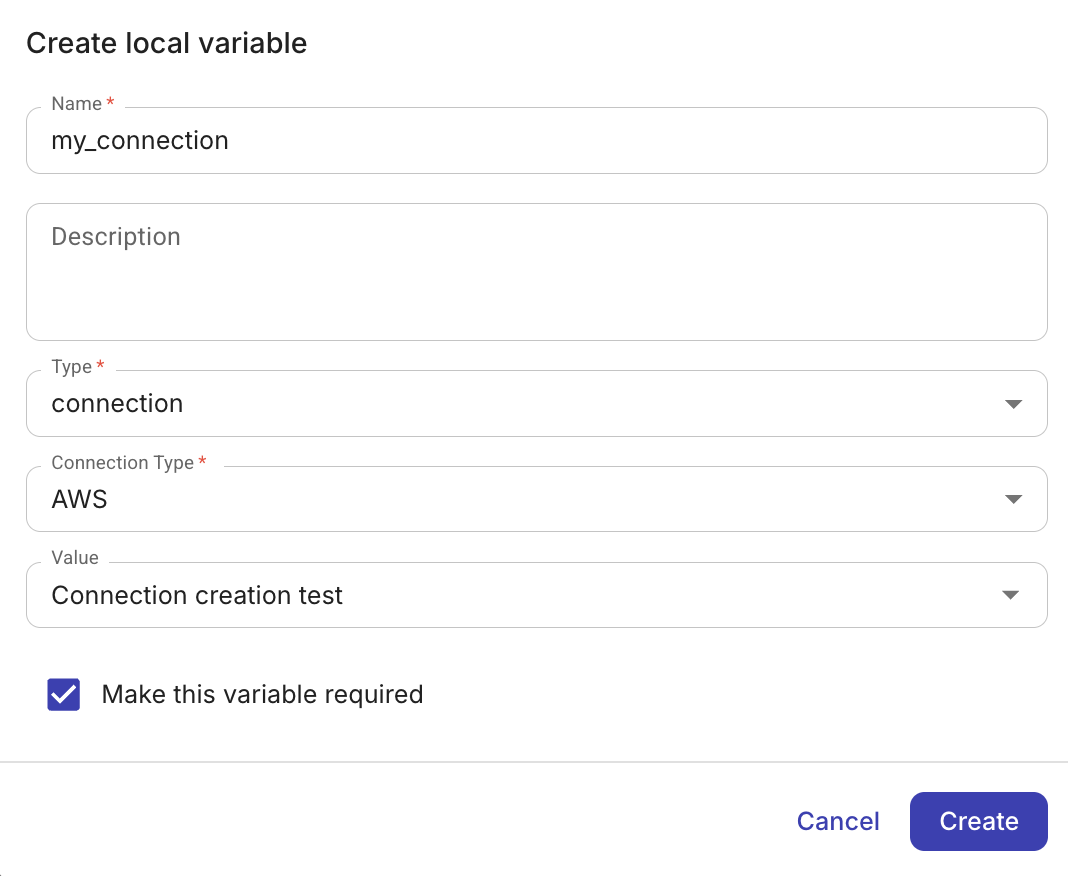
Define the variable:
-
Name: A name that fits the usage of the variable. Names must start with a letter or underscore and contain only letters, numbers, and underscores.
-
(Optional) Description: A brief description of what the variable is for.
-
Type: The data type:
string,integer,float,boolean,list,connection. If you choose list, you must also set Element Type. If you choose connection, you must also set Connection Type. -
Element Type: The type of each item in the list. Shown only when Type is list. Allowed values:
string,integer,float,boolean. Required when Type is list. -
Connection Type: The provider for the connection. Shown only when Type is connection. Possible values include AWS, GCP, OpenAI, and Anthropic. The options shown depend on which providers are enabled for your organization.
-
(Optional) Value: The value of the variable. For templates, you can define variables with only name, type, and description; users who use the template see clear placeholders and set values when they copy or open the flow, without editing the template itself. For a list variable, add or remove items; each item must match the element type. For a connection variable, select one of your organization's connections for the chosen Connection Type when you set a value.
-
Make this variable required: When checked, the variable must have a value before the flow can run. When creating a required variable, you do not have to set a value. For example, for a flow used as a subflow you can create an empty required local variable and specify it as a parameter in your flow so that the parent flow supplies the value at runtime. If a required local variable has no value when you save or publish (and is not supplied as a parameter), the flow status bar shows an error. Selecting the status error opens the variables panel.
-
-
Select Create. You can now add the variable from a flow.
Manage variables
You can edit and delete variables from the CloudFlow sidebar or the flow builder, depending on the scope of the variable. The following restrictions apply to editing and deleting variables:
-
Published flow: You cannot edit or delete variables while the flow is published. Unpublish the flow before making changes.
-
Variable in use: You cannot delete a variable that is referenced by one or more nodes in the flow. Remove the variable from all nodes before deleting it.
-
Type change: You cannot change a variable's type while it is referenced by any node in the flow. Remove the variable from all nodes before changing its type. Renaming a variable is always allowed because node references use the variable's ID, not its name.
Global variables
You can manage your global variables from Variables in the CloudFlow sidebar.
-
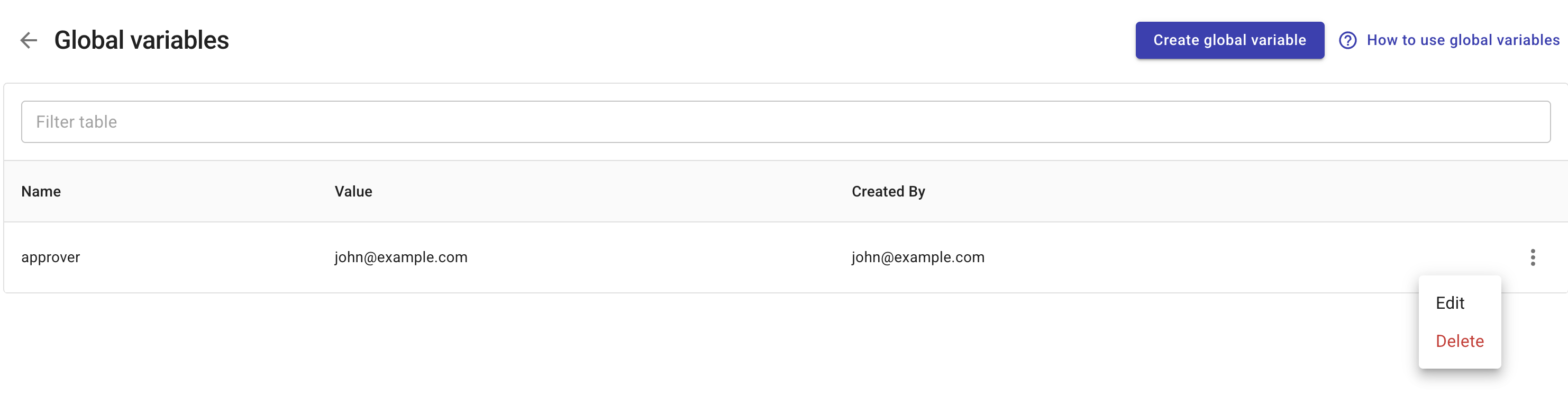
Select Automation and operations from the top navigation mega menu, select CloudFlow, and in the CloudFlow sidebar select Variables.
-
Select the kebab menu (⋮) on the rightmost end of the entry, and then choose the action to perform.
Local variables
You can edit or delete local variables from a flow. You can edit local variable values directly in the panel; changes are saved automatically when you move to another field and apply everywhere the variable is used in the flow. Use the three-dots menu on a variable to Edit (name, type, description, required, and options for the selected type) or Delete.
-
Open the flow whose variables you want to manage.
-
Select Variables.
-
Select the Local variables tab.
-
Select the kebab menu (⋮) on the rightmost end of the entry, and then choose the action to perform.