Attribute API
Attribute API enables one to interact with the data programmatically, extract large amounts of data and integrate it with your internal systems.
The following document will describe the authentication and endpoints available, response codes, and will provide some code examples for easy use of the Attribute API.
Authentication and Authorization
The authentication with the Attribute API is based on JWT (JSON Web Token).
For security reasons, once generated, the token cannot be recovered. Make sure you keep your token in a secure manner.
To generate your token, please access the Attribute Dashboard. Navigate to the setup/api-tokens page, where you will be able to create new tokens and manage your existing tokens.
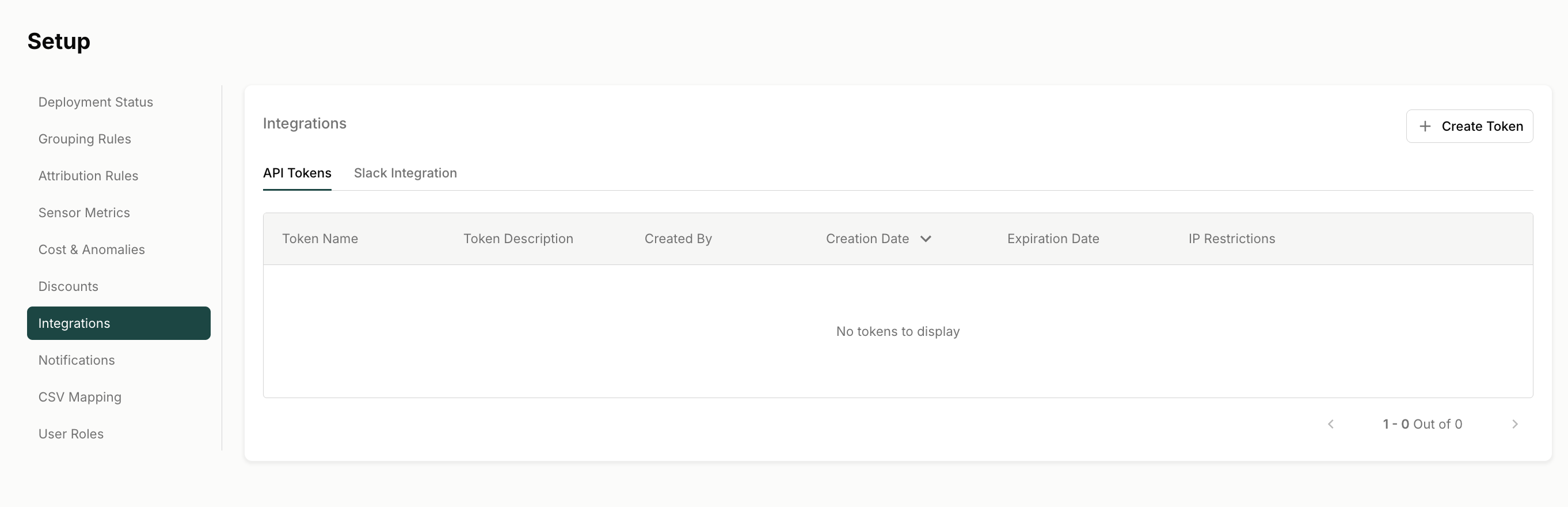
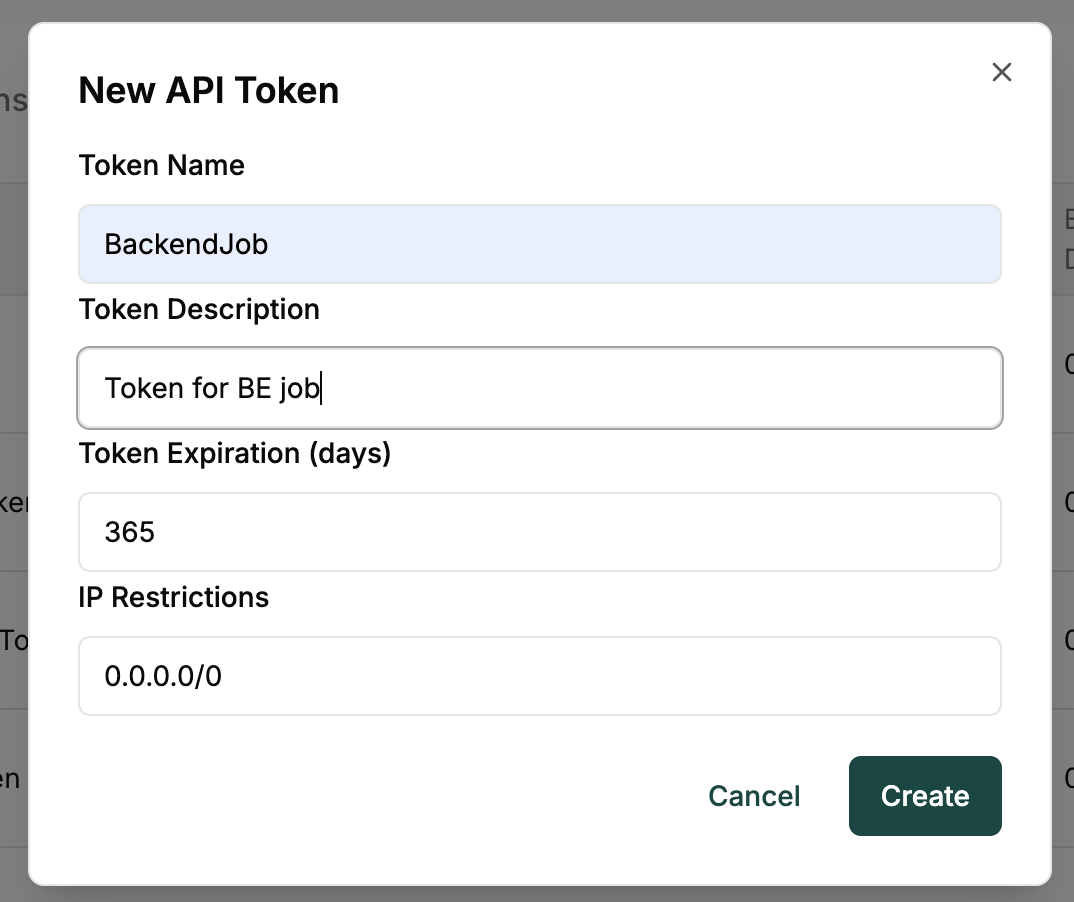
Click Create Token to open the new-token dialog. Provide a token name, description, expiration in days, and any IP restrictions, then click Create.
API Endpoints
AWS usually takes up to 48 hours to update the data, thus the earliest stable daily data is two days ago.
Granularity and Date Parameters
Most endpoints below accept two path parameters that follow the same conventions:
granularity:dailyto get data for a single day, ormonthlyto get data for the whole month.date: The date for which to fetch the data, in the formatYYYY-MM-DD.- When
granularityisdaily, the data corresponds to that specific day. Entering the current day fetches the data available so far; future dates return an empty response. - When
granularityismonthly, the day part of the date is ignored and the data covers the entire month. Entering the current month fetches the previous month's data; future months return an empty response. Example: if the date is2026-05-06and granularity ismonthly, the response will include data for April 2026.
- When
Healthcheck Information
Checks the health of the server.
- Endpoint:
/api/v1/health - Method:
GET - Example:
https://api.app.attrb.io/api/v1/health - Returns: HTTP 200 if the server is healthy.
Resources Information
The Resources Information endpoint returns billing data for individual cloud resources (the billing page in Attribute's dashboard).
- Endpoint:
/api/v1/resources/{granularity}/{date} - Method:
GET - Example:
https://api.app.attrb.io/api/v1/resources/daily/2025-11-10 - Description: Starts a job to fetch resources data.
- Parameters:
granularityanddate: See Granularity and date parameters.
- Query Strings:
includetags(boolean, optional): Iftrue, includes resource tags in the response. Defaultfalse.
- Returns:
JobDescription
Dashboard configurations show $0 cost and show tax are both treated as true in the API.
Workloads Information
The Workloads Information endpoint returns billing data aggregated by workload.
- Endpoint:
/api/v1/workloads/{granularity}/{date} - Method:
GET - Example:
https://api.app.attrb.io/api/v1/workloads/daily/2025-11-10 - Description: Starts a job to fetch workloads data.
- Parameters:
granularityanddate: See Granularity and date parameters.
- Query Strings:
includelabels(boolean, optional): Iftrue, includes resource labels in the response. Defaultfalse.
- Returns:
JobDescription
All Customers Information
The All Customers Information endpoint extracts customer insights from the Attribute platform across all cloud providers, such as the customer cost and amortized, effective, and GCP costs for the resources attributed to each customer. (For the detailed structure of the customer data, see AllCustomerEntryObject.)
- Endpoint:
/api/v1/allcustomers/{granularity}/{date} - Method:
GET - Example:
https://api.app.attrb.io/api/v1/allcustomers/daily/2026-05-01 - Description: Starts a job to fetch customer data across all cloud providers.
- Parameters:
granularityanddate: See Granularity and date parameters.
- Returns:
JobDescription - Result object:
AllCustomerEntryObject
Identifiers Information
The Identifiers Information endpoint returns compute cost broken down by identifier — a unit such as a customer, project, or country running on a shared cluster. This lets you see how a single cluster's cost splits across business units based on each identifier's share of requests.
Availability: AWS data only, and only for customers who have multiple units configured through sensor identifiers. For other customers, cost is reported through the standard customer cost flow (see All Customers Information).
- Endpoint:
/api/v1/identifiers/{granularity}/{date} - Method:
GET - Example:
https://api.app.attrb.io/api/v1/identifiers/daily/2026-06-02 - Description: Starts a job to fetch identifiers cost data.
- Parameters:
granularity: daily to get data for a single day (this endpoint supports daily granularity only)date: See date parameters.
- Returns:
JobDescription
Cost Calculation Types
Each workload + identifier combination is returned four times, once per cost_calculation_type. The type encodes two independent dimensions:
- Anonymous costs — whether the cost share of requests with no identifier is kept as-is, or redistributed across the identified groups.
- Unallocated costs — whether billing costs that could not be attributed to any workload are excluded or distributed across workloads.
cost_calculation_type | Anonymous costs | Unallocated costs |
|---|---|---|
with_anonymous_without_unallocated | Kept | Excluded |
with_anonymous_with_unallocated | Kept | Distributed |
without_anonymous_without_unallocated | Redistributed to identified groups | Excluded |
without_anonymous_with_unallocated | Redistributed to identified groups | Distributed |
AI Cost Information
The AI Cost Information endpoint retrieves AI cost from all clouds and direct providers — Bedrock, Vertex AI, OpenAI, Azure OpenAI, and Anthropic.
- Endpoint:
/api/v1/aicost/{granularity}/{date} - Method:
GET - Example:
https://api.app.attrb.io/api/v1/aicost/monthly/2025-11-01 - Description: Starts a job to fetch AI cost data.
- Parameters:
granularityanddate: See Granularity and date parameters.
- Returns:
JobDescription - Result object:
{
    "results": [
        {
            "granularity": "MONTHLY",
            "data_date": "2026-03-01",
            "cloud_provider": "OpenAI",
            "resource_type": "OpenAI",
            "resource_name": "attribute-cyopcu/gpt-5.2-2025-12-11",
            "token_type": "Output Tokens",
            "amortized_cost": 0.088521999999999976,
            "unblended_cost": 0.088521999999999976
        }
    ]
}
OpenAI Information
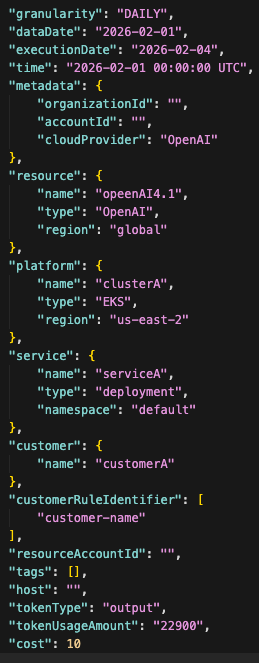
The OpenAI Information endpoint retrieves OpenAI-related insights per Customer and Workload from the Attribute platform.
Results are returned only if you have a native OpenAI integration in AWS configured, including a customer identifier.
- Endpoint:
/api/v1/reports/openai/{granularity}/{date} - Method:
GET - Example:
https://api.app.attrb.io/api/v1/reports/openai/monthly/2025-11-01 - Description: Starts a job to fetch OpenAI data.
- Parameters:
granularityanddate: See Granularity and date parameters.
- Returns:
JobDescription - Result object:
Job Management
Every data endpoint above returns a JobDescription with an id. Use the endpoints below to track and retrieve the job's results.
Job Status
- Endpoint:
/api/v1/job/{jobid}/status - Method:
GET - Example:
https://api.app.attrb.io/api/v1/job/{jobid}/status - Description: Retrieves the
JobDescriptionfor a specific job with its status. - Parameters:
jobid: The ID of the job.
- Returns:
JobDescription
Fetch
- Endpoint:
/api/v1/job/{jobid}/fetch - Method:
GET - Example:
https://api.app.attrb.io/api/v1/job/{jobid}/fetch - Description: Fetches the results of a completed job.
- Parameters:
jobid: The ID of the job.
- Query Strings:
maxResults(int, optional): Maximum number of objects insideJobData.resultsto fetch.token(int, optional): Token for pagination.
- Returns:
JobData
Status Codes
Attribute API uses standard HTTP status codes:
| Code | Meaning | Description |
|---|---|---|
400 | Bad Request | Failed to parse request parameters |
401 | Unauthorized | Request is not authorized |
404 | Not Found | Job is not completed or no data was found |
429 | Rate Limit | Too many requests were made for a single org |
500 | Internal Server Error | Server errors |
Data Structures
JobDescription
| Field | Description |
|---|---|
id | Job ID |
status | Job status: pending, running, completed, failed |
reason | Failure reason (applicable for failed status, optional) |
lastUpdate | Unix timestamp of last status update |
JobData
| Field | Description |
|---|---|
results | List of result objects |
nextToken | Optional integer for pagination — absent on the final page of results |
AllCustomerEntryObject
| Field | Description |
|---|---|
customer_name | Customer identifier |
organization_id | Attribute organization identifier |
granularity | Granularity of the data: DAILY or MONTHLY |
data_date | The date of the data |
execution_date | The date the job was executed |
data | Attribution data list |
data[].resource | Resource identifier object |
data[].resource.cloud_provider | Cloud provider type (e.g. AWS, Azure, GCP) |
data[].resource.account_id | Attribute account ID |
data[].resource.customer_rule_identifier | Attribution rule identifier |
data[].resource.resource_name | Resource name (e.g. EKS cluster name) |
data[].resource.resource_type | Type of resource (e.g. EC2-EKS) |
data[].resource.resource_region | Region of the resource (e.g. us-east-1) |
data[].cost | Attributed cost object |
data[].cost.amortized_cost | Amortized cost value (AWS, MongoDB® Atlas, OpenAI) |
data[].cost.effective_cost | Effective cost value (Azure) |
data[].cost.gcp_cost | Cost value (GCP) |
Code Examples
Request to the customers API for the daily data on 2026-05-01:
curl -X GET "https://api.app.attrb.io/api/v1/allcustomers/daily/2026-05-01" \
  -H "Accept: application/json" \
  -H "Authorization: Bearer <JWT Token>"
Response with the JobDescription for the created job:
{
    "id": "7a116c30-e245-43cb-b451-f099e84ffdeb",
    "status": "pending",
    "lastUpdate": 1741012038
}
Request for the status of Job ID 7a116c30-e245-43cb-b451-f099e84ffdeb:
curl -X GET "https://api.app.attrb.io/api/v1/job/7a116c30-e245-43cb-b451-f099e84ffdeb/status" \
  -H "Accept: application/json" \
  -H "Authorization: Bearer <JWT Token>"
Response indicating that the job has been completed successfully:
{
    "id": "7a116c30-e245-43cb-b451-f099e84ffdeb",
    "status": "completed",
    "lastUpdate": 1741012038
}
Request for 1 row of data:
curl -sG "https://api.app.attrb.io/api/v1/job/7a116c30-e245-43cb-b451-f099e84ffdeb/fetch" \
  --data-urlencode "maxResults=1" \
  -H "Accept: application/json" \
  -H "Authorization: Bearer <JWT Token>"
Response with a single row of data:
{
    "results": [
        {
            "customer_name": "acme_corp",
            "organization_id": "org-id",
            "granularity": "DAILY",
            "data_date": "2026-05-01",
            "execution_date": "2026-06-03",
            "data": [
                {
                    "resource": {
                        "cloud_provider": "AWS",
                        "account_id": "acct-id",
                        "customer_rule_identifier": "Proportions",
                        "resource_name": "prod-cluster",
                        "resource_type": "EC2-EKS",
                        "resource_region": "us-east-1"
                    },
                    "cost": {
                        "amortized_cost": 12.45,
                        "effective_cost": 0,
                        "gcp_cost": 0
                    }
                },
                {
                    "resource": {
                        "cloud_provider": "Azure",
                        "account_id": "azure-acct-id",
                        "customer_rule_identifier": "Proportions",
                        "resource_name": "vm-prod",
                        "resource_type": "VirtualMachine",
                        "resource_region": "eastus"
                    },
                    "cost": {
                        "amortized_cost": 0,
                        "effective_cost": 8.30,
                        "gcp_cost": 0
                    }
                },
                {
                    "resource": {
                        "cloud_provider": "GCP",
                        "account_id": "gcp-acct-id",
                        "customer_rule_identifier": "Proportions",
                        "resource_name": "gke-prod",
                        "resource_type": "GKE",
                        "resource_region": "us-central1"
                    },
                    "cost": {
                        "amortized_cost": 0,
                        "effective_cost": 0,
                        "gcp_cost": 5.72
                    }
                }
            ]
        }
    ],
    "nextToken": 363
}
Trademarks: AWS is a trademark of Amazon.com, Inc. or its affiliates. Microsoft and Microsoft Azure are trademarks of the Microsoft group of companies. Google Cloud is a trademark of Google LLC. MongoDB is a registered trademark of MongoDB, Inc. OpenAI is a trademark of OpenAI. Anthropic and Claude are trademarks of Anthropic, PBC. All other trademarks are the property of their respective owners.